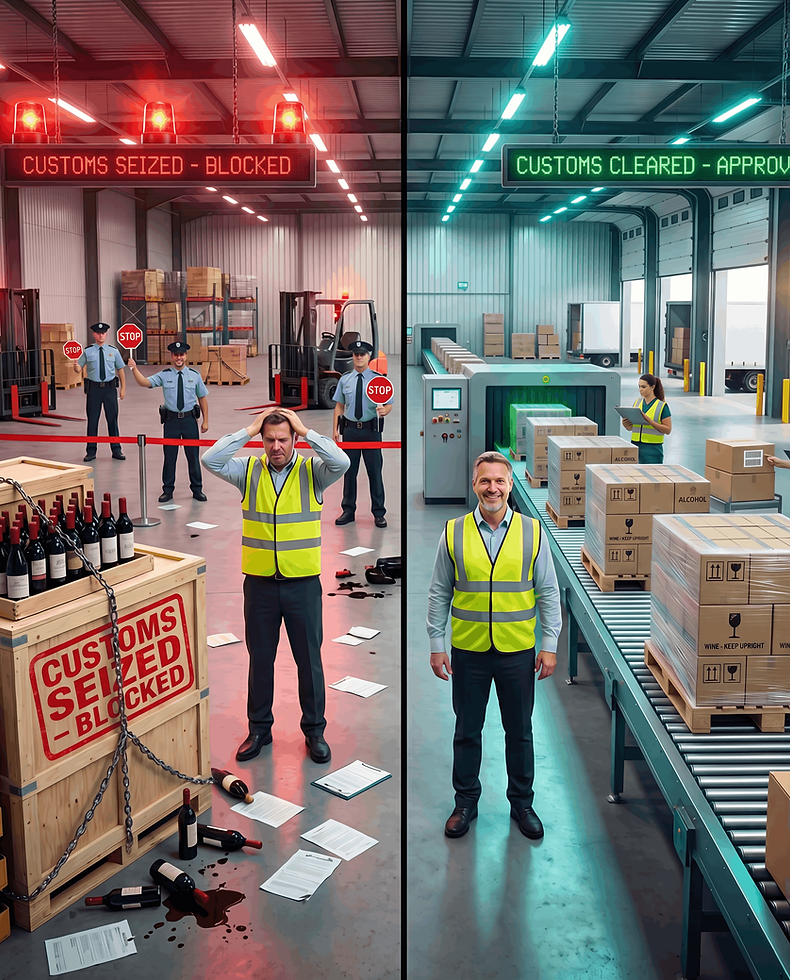
Shipment held up? End the uncertainty.
Discover how to turn every export of wine, beer, and spirits into an exact science, not a leap in the dark.
Exporting wine, beer, and spirits shouldn't be an act of faith — and yet, every time you sign the documents for a new shipment, it's as if you were rolling the dice, hoping that no blocks, no delays, no penalties come up.
You know it well — it's not about luck. It's that the system isn't designed to protect you, but to trap you at the worst possible moment. And so, once again, you find yourself holding your breath, because a case of Brunello has been stuck in Montreal for 8 days… and no one, not even your logistics consultant, can explain why.
You spent months negotiating with that Canadian buyer, you organised tastings, you negotiated, you waited — and now you risk losing everything because a classification code was missing, or because the local customs system didn't receive the EAD in time.
Not the first time, right? The truth is that every time you press "Send", a part of you dies. Because even when you think you have everything under control… you're hostage to a fragmented, outdated mechanism that's beyond your reach.
The problem isn't customs — the real problem is that you keep managing it as if it were 2005. With 3 different suppliers, with Excel files, with a consultant who only responds after the damage is done.
This is why every shipment is a gamble, why you can't sleep at night, why your team looks to you expecting answers you can't give.
Have you ever wondered why every other thing you've tried…
…fails? You've spent budget on elegant software that doesn't talk to customs, you've paid for hours of internal training that becomes useless paper after six months, you've handed excise duty over to suppliers who don't even know the difference between an Amaro and a Moscato.
Everything you've done… has only been applying patches. But you've never solved the real problem: fragmentation.
What if I told you there's a completely different way to export wine, beer, and spirits?
Not a patch, not yet another consultant, but an integrated system where everything — customs, excise, logistics — is orchestrated in a single flow.
Where every document is handled before it becomes an obstacle, where every shipment is monitored, tracked, completely under control, where you're no longer the firefighter putting out the flames — you're the Director orchestrating every movement with a click.
This system exists. It's called Alpentrans Customs & Excise. And it was created to put an end to the Russian roulette of shipments.
Because every time a bottle is held up at customs, you don't just lose money — you lose your customers' trust, you lose internal authority, you lose hours of sleep, family arguments, ruined weekends.
Enough. For years they've made you believe that "export is complicated for everyone", that "bureaucracy is just like that, nothing you can do about it", and that "you just have to hope it all goes smoothly".
Lies. Convenient lies, told by those who profit every time you make a mistake.
The one who loses is you — and the ones who win are the ones telling you that "it's normal".
Your worst enemy isn't customs — it's the compromise you accepted.
Now you know, and you can choose: you can keep living with the fear that yet another Japanese client will cancel the contract because "the goods are stuck" — or you can turn the logic upside down, and transform the very problem of customs and excise into your greatest competitive asset.
We'll show you how it works. We'll explain why Alpentrans's integrated, in-house approach is different from anything else — and most importantly, we'll tell you how it's changed the lives of people like you.
Export managers and producers of wine, spirits, and beer who used to live with a lump in their throat, and today… they have a dashboard showing green ticks everywhere.
Customers who used to threaten to walk away, today signing multi-year contracts.
Boards that used to doubt them, today promoting them as heads of international markets.
It's not just an efficiency question. It's your credibility. It's your future. It's the moment when you stop chasing problems… and start building opportunities.
Because export isn't a gamble.
It's an exact science — when you have the right tools.
And now, finally, you have them.

Finally, a different way to handle Customs & Excise
At Alpentrans, we've built an operational approach designed for the beverage sector: customs, excise, and logistics orchestrated in a single flow. A flow with clear accountability and preventive controls.
With an in-house team that follows shipments from start to finish. Here we don't talk about "promises". We talk about method. What changes for you?
You no longer need to coordinate three or four different parties. You no longer need to chase answers after the goods are already stuck. You no longer need to hope that "everything goes smoothly".
Because the process is set up properly before departure, and monitored throughout execution.
Why today's customs and excise create problems (even when you think everything's in order)
Many holds come from these factors, often underestimated: Every country has its own particularities and operational practices. Knowing "the general rule" isn't enough. You need to know how that rule is actually applied locally.
Required documents, formats, controls, authorisations, platforms, technical timing: they change.
The beverage sector is more sensitive — which means alcohol = more controls. More constraints. More responsibility.
And often more financial consequences when something doesn't add up. Fragmentation creates accountability gaps. Carrier, customs broker, excise office, customer, warehouse.
Everyone holds a piece. No one has the full command — and when there's a problem, the finger-pointing starts.
The errors are "small", but the impact is huge: a code, a description, an inconsistent data point.
They're details. But details that can stop a truck, a container, or a pallet.

The key: in-house expertise and operational oversight.
Customs and excise require real experience and continuity. At Alpentrans, management is handled by a specialised in-house team.
This matters for three concrete reasons:
-
Decision speed: problems are solved earlier, because the person who decides is inside the process.
-
Consistency: the same operational rules applied every time, with replicable controls.
-
Clear accountability: one single point of contact, one command, one integrated flow.
And most importantly: we don't just "handle the paperwork". We work to prevent the paperwork from becoming a problem.
Global know-how: we import from all over the world, we export everywhere!
Our know-how is high because it comes from managing international shipments every single day. Every route teaches something. Every country has specific requirements. Every client has different needs.
This experience makes the process more solid: less improvisation, more operational standards.
What Alpentrans does, very concretely!
Think of Alpentrans Customs & Excise as an "internal department" that takes complexity and risk off your shoulders.
Before the shipment:
Collection and verification of shipment data (goods, destination, roles, Incoterms, documents)
Consistency checks between documents and actual goods
Verification of classification and product descriptions
Check on specific requirements of the import/export country
Operational planning to avoid predictable holds
During the shipment:
Operational coordination between customs, excise, and logistics
Monitoring of document status and progress
Fast handling of exceptions and requests, with clear points of contact
After the shipment:
Organised, traceable archiving of documentation
Analysis of issues that emerged, and flow improvement
Standardisation for recurring shipments and growing volumes
Concrete benefits
Fewer holds, fewer delays
Because documents are validated upfront, and inconsistencies surface while there's still time to act.
Fewer unexpected costs
Demurrage, extra handling, urgencies, lost man-hours, penalties. When you reduce the "incidents", you reduce these costs too.
One flow, one single responsibility
No bouncing between different parties. No "that's not my department". You have one contact and one process.
More peace of mind, more credibility
When shipments run smoothly, the relationship with clients and buyers changes. And so does internal perception: you're no longer the one chasing problems.
What you get with Alpentrans

1. Customs management for beverage import/export
2. Excise management and operational oversight of the flow
3. Preventive checks on data and documents
4. One single contact, clear accountability, integrated process
5. Continuous support and constant improvement of flows
6. Possible operational integration with your own processes (when needed) to reduce manual work
How It Works, Step by Step!
We start with a concrete analysis of your flow to identify where risks arise on documents, accountability, and timing.
We map every step and define clear operational rules: who does what, when, with which controls. We activate the process with structured onboarding, checklists, and shared documentation standards across departments.
The first shipments are followed with direct supervision to stabilise the system.
Then the flow becomes a controlled routine: fewer exceptions, more predictability, more protected margin.
Phase 1 – Initial analysis of your flow
Understand where risks arise: documents, steps, responsibilities, timing.
Phase 2 – Mapping and operational rules
We define a replicable process: who does what, when, with which controls.
Phase 3 – Operational onboarding
We activate the flow, set up checklists and documentation standards, align the departments involved.
Phase 4 – Supervised launch
The first shipments are followed with maximum attention to stabilise the process.
Phase 5 – Controlled routine
The flow becomes stable: fewer exceptions, more predictability, more control.
Why it's different from "a consultant" or "a software"
A software doesn't take on operational responsibility. An external consultant often steps in once the problem has already exploded.
A fragmented process always creates blind spots. Alpentrans is an operational structure that works with you and for you, every day. With in-house expertise and a single command.
That's what turns customs from a risk into a competitive lever.


